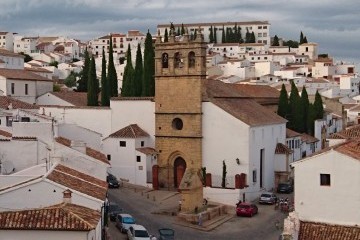
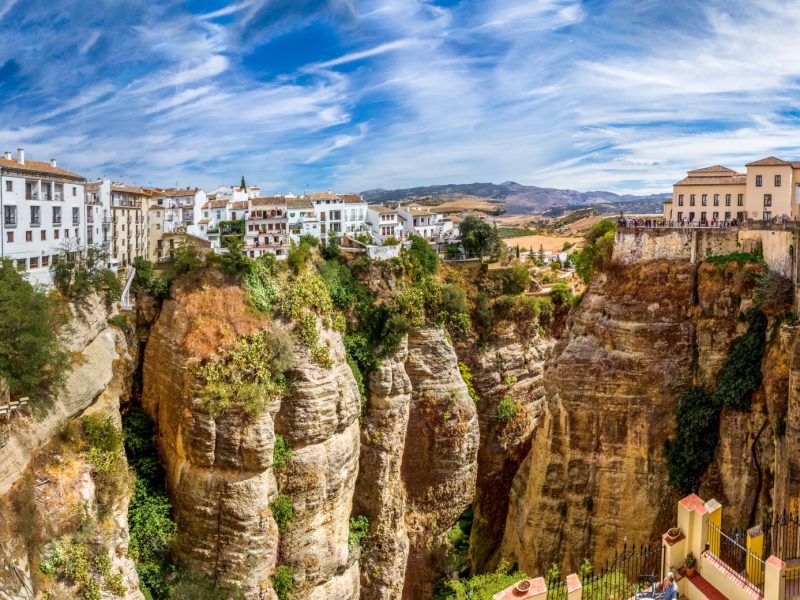
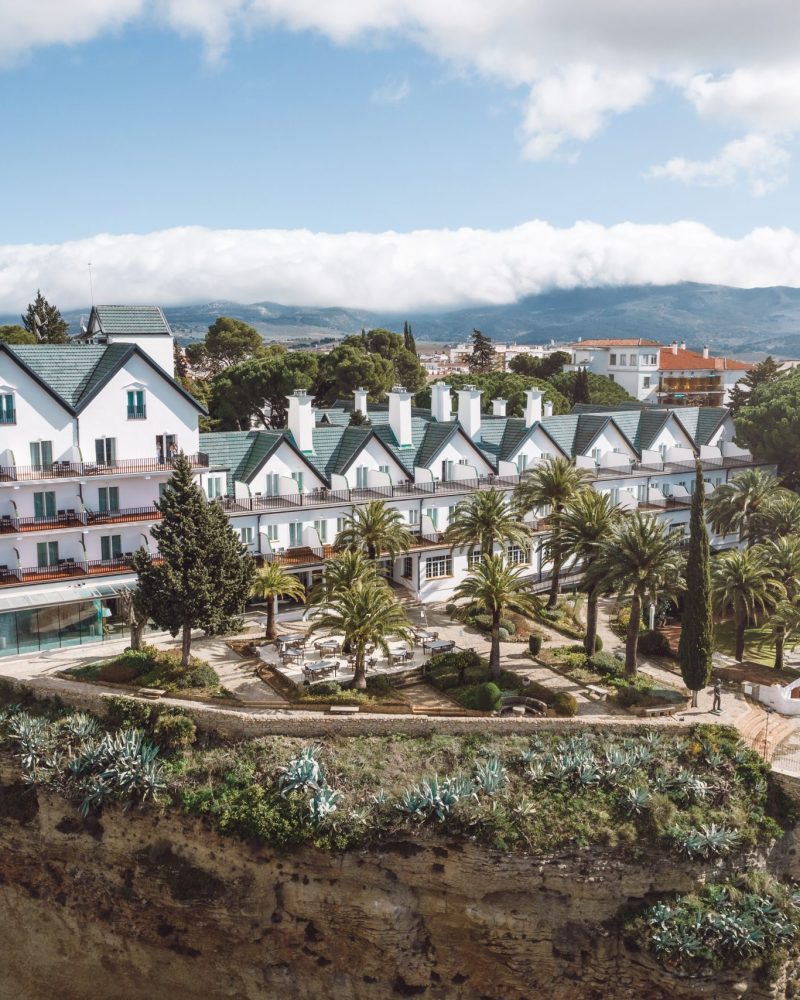
The route of the white villages in the mountains of Malaga is one of the most recommended tourist routes. And among them all, Ronda, in particular, is a marvel.
Lost in the mountains of the serranía that takes its name, this small town is home to architectural treasures on a par with the most beautiful cities in the world. In Ronda, you have a multitude of restaurants where you can sample the best of Andalusian cuisine, with a strong presence of local produce and many traditional stews.
Although its size makes it a place you could visit in a single day, Ronda is well worth at least four or five days of intensive tourism. Few towns in the world have so many places of interest in such a small area.
Ronda is synonymous with history, nature, tranquillity, art and culture. The natural wonders of its surroundings also make it a fantastic destination to enjoy hiking and practice sports such as Mountain Bike.
Table of Contents
Puente Nuevo
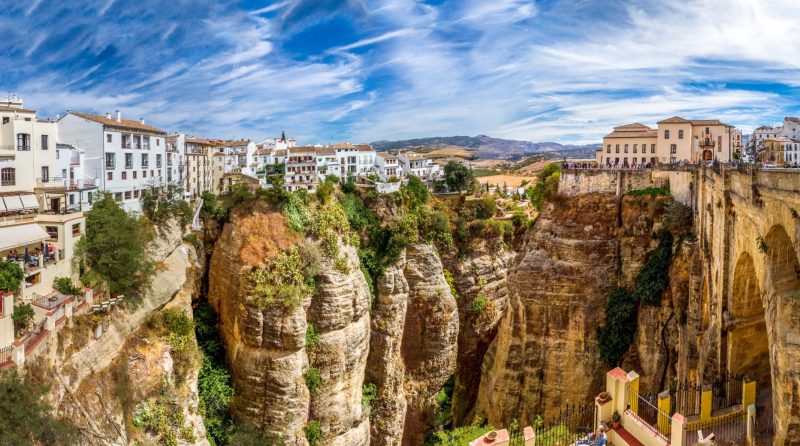
Ronda’s most iconic landmark, and one of Spain’s most stunning bridges, is the Puente Nuevo. The views of the Tajo de Ronda from its sidewalks, with the sheer drop of the gorge in between, are not suitable for people with vertigo. However, from there you can enjoy a truly amazing panoramic view.
This symbol of the town, 98 metres high and 35 metres in diameter, was built in stone in the middle of the 18th century to connect the city’s market district with the old quarter of the town.
Following an initial failed attempt, the destruction of which caused a fatal accident at the time, the bridge was raised a second time, learning from the mistakes of the first version. And so successful was it that even today, it continues to connect the two districts of Ronda with a steady flow of foot traffic every day.
Did you know that its interior can also be visited? There you can enter its Interpretation Centre, where you will learn more about this spectacular architectural work, as well as the flora and fauna that surrounds the municipality.
Bullring of the Royal Cavalry of Ronda
Ronda’s historic bullring, one of the city’s oldest and most remarkable structures, is a must-see.
Designated an Asset of Cultural Interest of Historical Heritage, it was officially inaugurated in 1785 with a bullfight starring the matadors Pedro Romero, a local bullfighter, and Pepe Hillo de Sevilla.
In the installations of the bullring it is possible to visit the Hall of the Bullring of the Royal Cavalry of Ronda, which offers a historical journey through the world of the nobility and cavalry of the town.
Other rooms open to the public include the Equestrian Gallery, located in the riding arena next to the bullring, and the Bullfighting Collection, the bullring’s private museum, where showcasing antique bullfighting attir, drawings, engravings and oil paintings from the 17th, 18th and 19th centuries.
Finally, the Royal Saddlery of the House of Orleans is also well worth a visit, a beautiful exhibition of harnesses and artisan accessories that once served as harnesses for the carriages of the Duke of Montpensier.
The Bullring of the Royal Cavalry of Ronda is a must-see even for those who do not like bullfighting, for its architectural beauty and numerous artistic works.
Church of Santa María la Mayor
A testament to Ronda’s rich architectural heritage, the 14th-century Gothic jewel is another of Ronda’s great architectural treasures. It was commissioned by the Catholic Monarchs, after the reconquest of the city from the Muslims. In fact, the church was built where the main mosque of Medina used to stand, and of this, the Mihrab arch, which you will find behind the altarpiece of the altar of the tabernacle, is still preserved.
Composed of three large naves, one of them was completely destroyed by an earthquake in 1580, which carried away most of its Gothic elements. Although this style can still be seen in its columns and in the arch’s moldings.
Two-tiered interior choir inside, corresponding to its most Renaissance facet, was carved in cedar and walnut wood.
Its impressive lower choir stalls are also noteworthy, with a total of 36 seats spread over two floors, with intricate religious carvings.
The end of its works is also perceived through several baroque elements, such as its impressive altarpiece of the Virgen del Mayor Dolor and the semicircular arch that opens the chapel of the image of the Virgen de los Dolores.
Arab Baths
The main Muslim vestige of the aforementioned Arab period in the city of Ronda.
Built between the 13th and 14th centuries, they are the best preserved Muslim thermal baths in Spain.
The baths are made up of three different chambers, each remarkably intact, offering a detailed glimpse of what this ancient place was like.
Visitors can experience a virtual recreation of how the facilities worked during the Andalusian era.
These medieval baths took their water from the Arroyo de las Culebras, which was distributed through its three main rooms: cold, warm and hot water.
In addition to these spaces, the baths have a reception area, two other large rooms and a boiler area.
This type of baths differed from the Roman baths in that while the Romans had large pools, these were steam baths.
Therefore, they are one of the best examples of the Muslim period in our country, due to their extraordinary level of preservation. So, if you are lucky enough to spend a few days on holiday in Ronda, they are without doubt a must-see.
Plaza de la Duquesa de Parcent
The Plaza de la Duquesa de Parcent is one of the best places to see in Ronda. A large, landscaped space marks the heart of Ronda’s former Muslim Medina and which today houses buildings such as the Convent of Charity, the Church of Santa María la Mayor, the Town Hall and even a school on what was once the old citadel.
This is the ideal place to start your visit to the city. Several of Ronda’s most important historic buildings are located here.
What’s more, the square has its own car park, so if you’re travelling by car, you can leave it just a few metres away.
Puerta de Almocábar
Hundreds of years ago, during the Moorish era, the Puerta de Almocábar was the entrance to the city and today it is still one of the best places to see in Ronda.
This monumental gate gets its name from its proximity to the Muslim cemetery, known as Al-Magabir in Arabic.
You will find it at the end of the popular Calle Armiñán, one of the busiest streets in the town.
Its first stones date back to the 13th century, first built by the Arabs and later restored by King Charles V.
It is made up of three large gates, situated successively one after the other, and two enormous towers in which the guards guarded the entrance and exit of the municipality.
It was there, on May 20th, 1485, that all the Castilian troops of the Marqués of Cádiz were placed in order to recover the city, ultimately reclaiming the city and ending Moorish rule in Ronda.
Mondragón Palace
Once again, we find a building that combines a clear Mudejar style with details more typical of Renaissance architecture.
The Palace of Mondragón served as the residence of the Benimerín King Abd al Malak and later, once the city was reconquered, of the Catholic Monarchs.
Nowadays, the palace is home to the Municipal Museum of Ronda, where you will find a complete collection of local history and culture. It is one of Andalusia’s leading museums in terms of archaeology.
During your visit, you will be able to admire its three beautiful interior courtyards, especially its spectacular Mudejar-style courtyard, which, like its façade, is remarkably well-preserved, with fountains and well-tended gardens.
Paseo de los Ingleses
While Ronda’s dramatic cliffs may pose a challenge for those with a fear of heights. If you don’t suffer from vertigo, its routes and paths can be a truly magical experience.
This is the case, for example, of the so-called Paseo de los Ingleses, which starts from the Plaza de España and goes along the gorge towards the Mirador de Ronda.
The views, both of the town and of the surrounding countryside, are truly amazing, especially when you reach the viewpoint. From there, you can also easily connect on foot with other places and monuments to visit in Ronda, such as the aforementioned Bullring of the Royal Cavalry of Ronda.
House of the Moorish King
Nestled beside the Cuesta de Santo Domingo, just a few metres from the Old Bridge of Ronda, you will find this beautiful 14th-century palace, which was once designed to supply water to the town in the event of a siege. Hence, it had its own Water Mine and a large waterwheel to extract it.
It was here that the battle was decided in favour of the Christian army, who, aware of the existence of the mine, focused their attacks on the waterwheel to stop the water supply in the city and force its surrender.
It is now open to the public and allows you to visit the impressive water mine, an engineering work far ahead of its time. As you descend into the mine and reach the Guadalevín river, you can enjoy wonderful views of the gorge.
The palace itself is also very attractive, with a multitude of details in a marked Neo-Mudéjar style and beautiful gardens that are well worth a stroll.
Minaret of San Sebastián
We continue to list treasures from the municipality’s Moorish heritage. This one in particular stands in stark contrast with the rest of the architectural elements that surround it, both in form and colour.
Situated on one of the edges of a small square of white houses, the Minaret of San Sebastián, some 8 metres high, seems to watch over the rooftops of the town.
During the Arab period it was not so high, as its first two floors actually come from it. The third floor was added by the Christians in order to place bells on it.
Originally, this beautiful minaret was part of one of Ronda’s mosques, and many years later, in 1931 its perfect state of preservation led to its declaration as a Historic-Artistic Monument.
Padre Jesús quarter
The Padre Jesús quarter is made up of a labyrinth of narrow streets, where several of the city’s most emblematic buildings and monuments are located.
Some important examples are the Fountain of the Eight Spouts or the Plaza del Socorro. In the latter, the old Casino of the town, the Church of Socorro, the fountain of Hércules and the sculpture of Blas Infante, the father of the Andalusian homeland, await you.
Among the most popular streets in the neighbourhood, Carrera de Espinel stands out for its marked commercial character, being one of the best places in the municipality for shopping.
Not far from there, Calle Bola is the ideal place to enjoy some good tapas or sit down to eat in a good restaurant and taste the delicacies of the wonderful local cuisine.
Finally, in Calle Virgen de los Remedios, also in the neighbourhood, you will find the church that gives it its name, the Church of Padre Jesús, famous for its Maundy Thursday procession.
The Walls of Ronda
If there is one thing that defines Ronda, it is remarkably preserved historical treasures of each and every one of its various historical treasures. Its walls are another good example of this, with their towers and large gates that even today still seem to ensure the security of the town.
The Walls of Ronda are made up of three main sections: the southern wall, the wall of the Albacara or Poniente and the Wall of the Cijara or the Levante, located further west.
Following the southern walls, you will come across the aforementioned Puerta de Almocábar and the Esparteros Gate. In the Western Wall, the Puerta del Viento (Wind Gate) and the Puerta del Cristo (Christ’s Gate) await you. And lastly, in the Levante Wall you will find the Puerta de la Cijara.
We highly recommend that you take a few minutes to stroll along the side of this centuries-old wall, passing through its various gates and enjoying its breathtaking views.
El Caminito del Rey (The King’s Little Pathway)
A short distance from Ronda lies El Caminito del Rey, is one of the best places to see near Ronda and a highly recommended excursion if you find yourself enjoying a holiday there for several days.
Again, we are talking about a plan for adventurous travellers, who are not afraid of heights and like a good hike.
Located between the municipalities of Álora, Ardales and Antequera, this is an enabled path right next to the Gaitanes Gorge.
Originally, this amazing route was considered one of the most dangerous among mountain sports lovers. But a recent remodelling has turned it into a 100% safe experience, without losing any of its spectacular nature.
To access it, you can get your tickets at the ticket office or in advance by booking online. Important: entrance is not allowed for children under 8 years old.
To get there from Ronda, you can take a bus that will take you there in just over an hour. Or if you are travelling by car, you can come directly with your car, as it has its own dedicated parking area.
Frequently Asked Questions Ronda
What places can’t you miss in Ronda?
Among the places you can’t miss in Ronda, we especially recommend the Puente Nuevo (New Bridge), the Bullring of the Royal Cavalry of Ronda and the Arab Baths. Although from our point of view you can’t miss any of the places on the list.
Where to eat in Ronda?
Ronda’s cuisine is one of the most famous in Andalusia, with typical dishes as delicious as migas rondeñas, cochifrito or broad beans with tomato.
Although it is easy to find a good restaurant where you can taste all these delicacies in almost any corner of the city, Calle Bola is the street with the most options.
When to travel to Ronda?
If we had to choose the months when it is most pleasant to travel to Ronda, both in terms of temperature and the number of tourists you can find in its streets, we would choose March, April, May, June, September and October.
How long does it take to see Ronda?
If you visit quickly, it takes a day to see Ronda and its main attractions. But truth be told, if you want to really enjoy all its charms you’ll need at least a weekend. If it’s a three or four day long weekend, so much the better.
How to get to Ronda?
The best way to travel to the beautiful town of Ronda is by car, as its location, surrounded by mountains, makes it difficult to reach by public transport.